How to Do a 3-minute Book Review Article
What Is a Literature Review | Footstep-by-Step Guide & Examples
A literature review is a survey of scholarly sources on a specific topic. Information technology provides an overview of current knowledge, allowing you to identify relevant theories, methods, and gaps in the existing research.
Writing a literature review involves finding relevant publications (such as books and journal articles), critically analyzing them, and explaining what you found. There are five key steps:
- Search for relevant literature
- Evaluate sources
- Identify themes, debates and gaps
- Outline the structure
- Write your literature review
A good literature review doesn't merely summarize sources—information technology analyzes, synthesizes, and critically evaluates to give a clear picture of the state of knowledge on the subject.
What is the purpose of a literature review?
When you write a thesis, dissertation, or research paper, y'all volition have to behave a literature review to situate your research within existing knowledge. The literature review gives y'all a take a chance to:
- Demonstrate your familiarity with the topic and scholarly context
- Develop a theoretical framework and methodology for your enquiry
- Position yourself in relation to other researchers and theorists
- Testify how your research addresses a gap or contributes to a debate
You lot might also have to write a literature review as a stand up-lone assignment. In this instance, the purpose is to evaluate the current state of enquiry and demonstrate your knowledge of scholarly debates effectually a topic.
The content will look slightly different in each instance, simply the process of conducting a literature review follows the same steps.
Writing literature reviews is a particularly important skill if you desire to apply for graduate schoolhouse or pursue a career in research.
Footstep 1: Search for relevant literature
Earlier y'all brainstorm searching for literature, y'all need a clearly divers topic.
If y'all are writing the literature review section of a dissertation or research paper, you volition search for literature related to your research problem and questions.
If you are writing a literature review as a stand up-alone assignment, you lot will have to cull a focus and develop a central question to direct your search. Unlike a dissertation research question, this question has to be answerable without collecting original information. Y'all should be able to answer it based only on a review of existing publications.
Make a listing of keywords
Start by creating a list of keywords related to your research question. Include each of the key concepts or variables you're interested in, and list whatsoever synonyms and related terms. You can add to this list if you discover new keywords in the process of your literature search.
- Social media, Facebook, Instagram, Twitter, Snapchat, TikTok
- Body image, cocky-perception, self-esteem, mental health
- Generation Z, teenagers, adolescents, youth
Search for relevant sources
Utilize your keywords to begin searching for sources. Some useful databases to search for journals and articles include:
- Your university'southward library catalogue
- Google Scholar
- JSTOR
- EBSCO
- Project Muse (humanities and social sciences)
- Medline (life sciences and biomedicine)
- EconLit (economics)
- Inspec (physics, engineering and estimator science)
You can use boolean operators to help narrow down your search:
- AND: to find sources that contain more than one keyword (east.grand. social media AND body epitome AND generation Z)
- OR: to find sources that contain ane of a range of synonyms (eastward.1000. generation Z OR teenagers OR adolescents)
- Non: to exclude results containing certain terms (e.g. apple NOT fruit)
Read the abstract to find out whether an article is relevant to your question. When you find a useful book or article, you can check the bibliography to find other relevant sources.
To identify the most important publications on your topic, take note of recurring citations. If the same authors, books or articles go on appearing in your reading, make sure to seek them out.
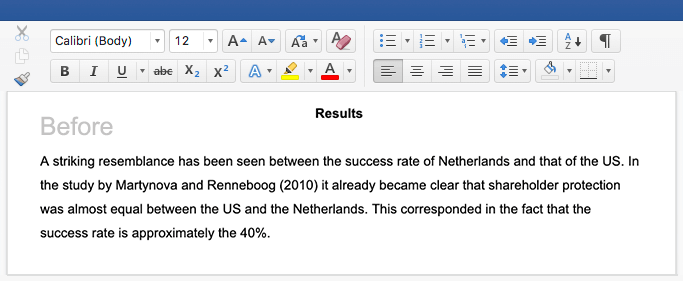
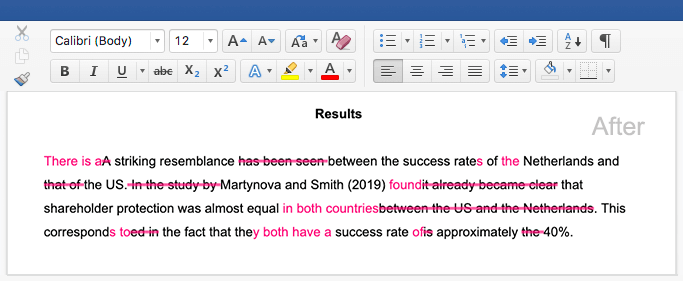
What can proofreading do for your paper?
Scribbr editors non just correct grammar and spelling mistakes, merely also strengthen your writing by making sure your paper is free of vague language, redundant words and bad-mannered phrasing.
See editing case
Footstep 2: Evaluate and select sources
You lot probably won't be able to read absolutely everything that has been written on the topic—you'll take to evaluate which sources are most relevant to your questions.
For each publication, ask yourself:
- What question or problem is the author addressing?
- What are the key concepts and how are they defined?
- What are the fundamental theories, models and methods? Does the enquiry employ established frameworks or take an innovative approach?
- What are the results and conclusions of the study?
- How does the publication relate to other literature in the field? Does it confirm, add to, or claiming established noesis?
- How does the publication contribute to your understanding of the topic? What are its fundamental insights and arguments?
- What are the strengths and weaknesses of the inquiry?
Brand sure the sources you use are credible, and make certain you read any landmark studies and major theories in your field of research.
You can find out how many times an article has been cited on Google Scholar—a high citation count ways the article has been influential in the field, and should certainly be included in your literature review.
The scope of your review volition depend on your topic and field of study: in the sciences you lot ordinarily only review recent literature, but in the humanities you might have a long historical perspective (for example, to trace how a concept has changed in meaning over time).
Accept notes and cite your sources
Every bit you read, you should as well begin the writing process. Accept notes that y'all can later on incorporate into the text of your literature review.
It is of import to go along track of your sources with citations to avert plagiarism. It can exist helpful to make an annotated bibliography, where you compile full citation information and write a paragraph of summary and analysis for each source. This helps you think what you read and saves time later on in the process.
Step 3: Identify themes, debates, and gaps
To begin organizing your literature review's argument and construction, you need to empathize the connections and relationships between the sources you've read. Based on your reading and notes, you lot can wait for:
- Trends and patterns (in theory, method or results): exercise certain approaches become more or less popular over fourth dimension?
- Themes: what questions or concepts recur across the literature?
- Debates, conflicts and contradictions: where do sources disagree?
- Pivotal publications: are there any influential theories or studies that inverse the direction of the field?
- Gaps: what is missing from the literature? Are there weaknesses that need to be addressed?
This step will help you piece of work out the construction of your literature review and (if applicable) show how your own research volition contribute to existing cognition.
- Most research has focused on young women.
- There is an increasing involvement in the visual aspects of social media.
- Only there is still a lack of robust enquiry on highly visual platforms like Instagram and Snapchat—this is a gap that yous could address in your own research.
Footstep four: Outline your literature review's structure
At that place are various approaches to organizing the torso of a literature review. You lot should have a rough thought of your strategy before you start writing.
Depending on the length of your literature review, yous can combine several of these strategies (for instance, your overall construction might be thematic, only each theme is discussed chronologically).
Chronological
The simplest arroyo is to trace the development of the topic over time. Nonetheless, if yous cull this strategy, exist careful to avoid simply listing and summarizing sources in order.
Endeavour to analyze patterns, turning points and key debates that have shaped the direction of the field. Give your interpretation of how and why certain developments occurred.
Thematic
If you take constitute some recurring central themes, you can organize your literature review into subsections that address different aspects of the topic.
For example, if you are reviewing literature about inequalities in migrant health outcomes, key themes might include healthcare policy, language barriers, cultural attitudes, legal status, and economic access.
Methodological
If you depict your sources from different disciplines or fields that employ a diverseness of research methods, y'all might want to compare the results and conclusions that emerge from different approaches. For case:
- Expect at what results have emerged in qualitative versus quantitative research
- Discuss how the topic has been approached past empirical versus theoretical scholarship
- Split up the literature into sociological, historical, and cultural sources
Theoretical
A literature review is often the foundation for a theoretical framework. You can utilise it to discuss various theories, models, and definitions of key concepts.
You might argue for the relevance of a specific theoretical approach, or combine various theoretical concepts to create a framework for your inquiry.
Stride 5: Write your literature review
Like any other academic text, your literature review should accept an introduction, a main body, and a determination. What you lot include in each depends on the objective of your literature review.
Introduction
The introduction should clearly establish the focus and purpose of the literature review.
Body
Depending on the length of your literature review, you might want to divide the body into subsections. You can utilize a subheading for each theme, time menstruum, or methodological approach.
Every bit you write, you can follow these tips:
- Summarize and synthesize: give an overview of the main points of each source and combine them into a coherent whole
- Clarify and translate: don't only paraphrase other researchers—add your own interpretations where possible, discussing the significance of findings in relation to the literature every bit a whole
- Critically evaluate: mention the strengths and weaknesses of your sources
- Write in well-structured paragraphs: use transition words and topic sentences to draw connections, comparisons and contrasts
Decision
In the conclusion, you should summarize the key findings you have taken from the literature and emphasize their significance.
When yous've finished writing and revising your literature review, don't forget to proofread thoroughly earlier submitting. Not a linguistic communication practiced? Bank check out Scribbr's professional Proofreading & Editing service!
Free lecture slides
This commodity has been adapted into lecture slides that you can employ to teach your students near writing a literature review.
Scribbr slides are free to utilize, customize, and distribute for educational purposes.
Open Google Slides Download PowerPoint
Oftentimes asked questions
- What is the purpose of a literature review?
-
There are several reasons to deport a literature review at the beginning of a research project:
- To familiarize yourself with the current state of noesis on your topic
- To ensure that you're not just repeating what others have already done
- To identify gaps in knowledge and unresolved problems that your inquiry can address
- To develop your theoretical framework and methodology
- To provide an overview of the key findings and debates on the topic
Writing the literature review shows your reader how your work relates to existing research and what new insights it will contribute.
Is this article helpful?
You have already voted. Cheers :-) Your vote is saved :-) Processing your vote...
Source: https://www.scribbr.com/dissertation/literature-review/
0 Response to "How to Do a 3-minute Book Review Article"
Post a Comment